
Introduction
Tesla’s ambitious push toward autonomous driving has once again drawn the attention of federal regulators. The company’s Full Self-Driving (FSD) system, which aims to let vehicles navigate roads with minimal human input, is now under investigation for potential traffic safety violations. As questions about reliability and public safety grow, the spotlight intensifies on one of the most controversial innovations in modern automotive technology.
What Is Tesla’s Full Self-Driving System?
Tesla’s Full Self-Driving (FSD) is an advanced driver-assistance feature designed to automate most aspects of driving, from lane changes to navigating intersections. While marketed as “self-driving,” the system still requires the driver to remain attentive and ready to take control at any moment.
Key features of the FSD package include:
-
Automatic lane changing and highway navigation
-
Traffic light and stop sign recognition
-
Smart Summon (car drives to the owner in parking lots)
-
Autopark and auto-steering capabilities
Despite these innovations, FSD has repeatedly faced criticism for misleading terminology and inconsistent performance, leading to several government investigations over the years.
Why Tesla Is Under Investigation
The latest probe by U.S. regulators focuses on how Tesla’s FSD behaves in complex traffic scenarios and whether it complies with road safety standards. Authorities are analyzing incidents involving Teslas that were reportedly operating under FSD or Autopilot when collisions occurred.
According to reports, regulators are particularly concerned about:
-
Unexpected braking or acceleration that could confuse nearby drivers.
-
Failure to detect traffic signals or obstacles in time.
-
Driver misuse — overreliance on automation, resulting in slower reaction times.
-
Software updates that are deployed without official safety testing or certification.
The National Highway Traffic Safety Administration (NHTSA) has requested detailed data from Tesla, including video recordings and crash logs, to assess whether the company’s software poses a risk to public safety.
Elon Musk’s Response to Safety Criticism
Tesla CEO Elon Musk has consistently defended the FSD program, arguing that the software statistically reduces the likelihood of accidents compared to human drivers. He claims that with more data and machine learning, the system will only get safer over time.
However, critics argue that Tesla’s naming and marketing strategy can mislead consumers into thinking their cars are fully autonomous when they are not. Industry experts have urged clearer labeling and stricter oversight to prevent misuse.
What This Means for Tesla Drivers and the Future of AI Cars
The outcome of this investigation could have major implications for both Tesla and the broader self-driving car industry. If regulators determine that the software poses safety risks, Tesla may face:
-
Mandatory recalls or software revisions
-
Increased legal scrutiny and penalties
-
New safety regulations for autonomous driving systems
Meanwhile, automakers developing similar technologies are closely watching how this investigation unfolds, as it could set new standards for AI-driven mobility worldwide.
Conclusion
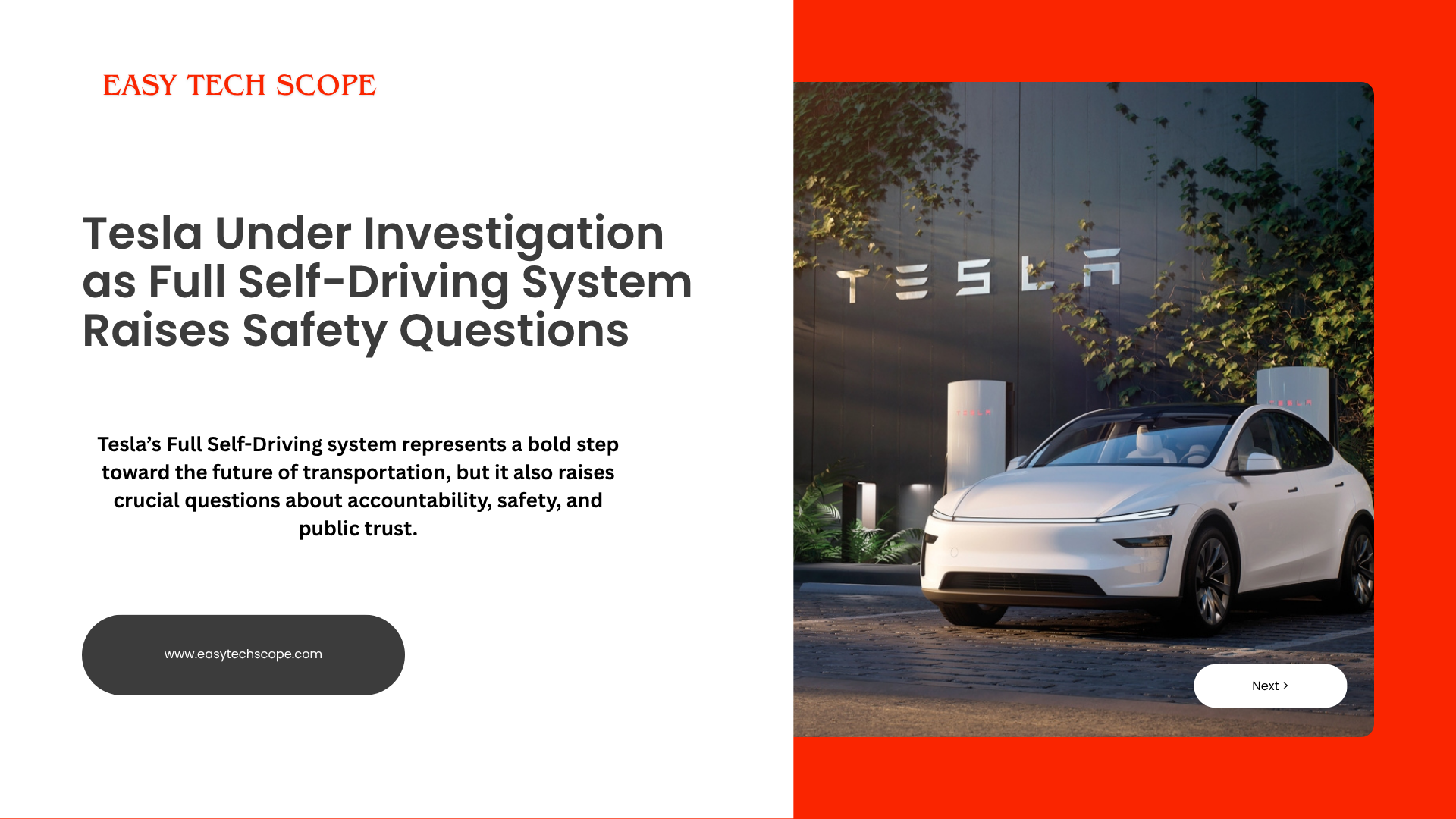
Tesla’s Full Self-Driving system represents a bold step toward the future of transportation, but it also raises crucial questions about accountability, safety, and public trust. As federal regulators dig deeper into its potential risks, the balance between innovation and responsibility will define not just Tesla’s future — but the future of self-driving technology itself.